Monday, February 11, 2019

Instagram Live: Links Between Declutter and Mental-Well Being

Recap of Heather and Olivia's Instagram Live in Downloadable PDF

Thank you to all of you who tuned into our Instagram live on February 11th!

We have put together a downloadable PDF summary of the main takeaway point from our Instagram Live!

Download the PDF here!


Please reach out if you have any questions or want to share your experiences with us! You can follow Heather at @heathergorr and find me on Instagram at @detoxdeclutterdesign !


SHARE:

Sunday, February 3, 2019

So You've Decluttered - Now What?

What to do with all the stuff you no longer want after the decluttering purge


I received the question recently, about any tips I had or suggestions on what to do with all the bags of stuff you are left with at the end of your decluttering marathon. This question was such an obvious topic for a post I couldn't believe I had glazed over it. But if you have never done a really good purge before, or even if you have but now there's just so much stuff, this is a really important topic to get some overall insight on!

In this post, I have provided a few tips on what I suggest you do with your stuff post-purge.

I love this little image of "Maslow's Hierarchy of Needs" made into a minimalist 'buyarchy' but it is so fitting to this topic. Instead of how you can buy close, you can look at this pyramid as a way of getting rid of clothes too. It sums up a few of the suggestions for getting rid of your stuff in an ethical and smart way.

Sell 

This one is all about you gaining from this situation. I know it can be difficult to give away items that were expensive but if they are not sparking joy or are a necessity then there is no reason to keep them. Therefore, see if you can sell some of these items. Depending on where you are in the world there are different stores that facilitate this process. They are picky and will not take everything, so do this step first and see how much you can get rid using this method (and how much extra change you can make)!

On the topic of selling, there are some really great organizations who will buy your clothes back from you in order for them to create new items!  One that I think is really great is Re-Spun, a revoluntionary recycling program that will give your old tee a new life. If you want to make some cash off of your old items, this organization will give you $5 for each tee you send them. That, if anything, should movitate you to not just throw your old items in the trash!

Gift 

Not everything we let go of is immediately "broken". Sometimes we just don't use them anymore and what is the use in having them when they just sit in the back of our closet or in a storage box? Ask your friend, roommate, sibling, parent if they could use the things you are getting rid of, and gift it to them. Maybe you just think it would suit them and it can be a birthday or no-reason gift. If it is in good condition, there's no harm in passing it on.

Be careful: You have just done an amazing job decluttering your space. You are in the right mindset and understand your criteria of the items you will intentionally bring into your space from now on. It is important to remember that not everyone has your perspective. Be conscious of the fact that family or friends are not just taking the items because they don't want you throwing them out. This means that the items do not spark joy for them either, but they have grown up with the mindset that things should not be thrown out, or whatever their case may be. That is completely okay, but just be suore to not "force" items on them that they may be taking out of guilt.

Swap 

Organizing a swap party can be a fun activity to do with your friends. The concept is that you all bring a few items and swap whilst having food and drinks ... My preference would be some red wine and a charcuterie board!

Be careful: See above "be careful" comment under the gifts section. Again, you are in a strong mindset right now for intentionally allowing things into your life. Be careful to only take something at a swap that truly sparks joy for you. Don't take it because someone else tells you it looks good on you. Don't take it cause you feel bad. You know that you just purged your house and that you are amazing. Stay in that mindset!

Donate 

I have left "donation" until the end because it is the most common one. At the same time, it depends on where you are donating. Some aid programs who send clothes oversees, generally countries in the global south, to places that already have an excess of items that just build up in a mini-landfill type situation. The toxins from the clothes result in more harm than good as they sit and rot. Check out the Netflix documentary The True Cost if you are intersted in learning more about this topic!

I recommend doing some research into what types of thrift stores and organizations you have in your area. A great idea is a women's shelter or goodwill. My wonderful friend Heather shared her decluttering story with me, after asking where to best bring all the things she was getting rid of. She went to a women's shelter in her area and right when she got there, a woman who had just lost everything showed up and ended up taking most of the items Heather had donated. She shared with Heather that all of these donations was a sign to her that she had made the right choice in finding safety and getting out of a dangerous relationship.

Point is, there are many local places and people that need your help. Look into what is in your area, what they do with donations (i.e. do they have a store, do they send them off somewhere, etc.) to gain some insight in who you will be helping. Such an experience will fill you with warmth and gratitude and encourage you to continue to declutter and donate as appose to throw away.


So there you have it - my recommendations for what you should do with all your stuff after you have decluttered. I also suggest you donate, swap, or sell your items relatively quickly so you don't let them just lay around.

Have you decluttered? Which of these methods did you use to ulimatle get rid of your stuff? Share with me!


SHARE:

Wednesday, January 23, 2019

Plant-Based Spaghetti Carbonara with Tempeh Bacon and Sweet Potato Spirals

Indulge in this plant-based take on carbonara to your heart's content


This recipe is super quick and easy to make and recreate in your own kitchen for a fast 30-minute weeknight dinner when the last thing you want to do is cook and you wish you were more into meal-prepping. 

The carbonara recipe is the result of playing around with the ingredients in my kitchen and mixing together different recipes. I got the seasoning recipe for the tempeh bacon from my wonderful Christmas present, the Fresh Cookbook. I changed a few things because I did not have all the ingredients in my kitchen so I will add it seasoning mixture to the recipe below as well.

I would 100% recommend including sweet potatoes into your version of this recipe. If you don't have a spiralizer, simply chop the sweet potatoes into little cubes or thin slices. The sweetness is the perfect balance with the savory tempeh bacon. But basically, the sweet potatoes are non-negotiable in my opinion!

So, without further delay, let's make some plant-based pasta! And as a reminder, like all of my recipes, the amounts are for approximately two people or for a single person plus leftovers, so adjust accordingly.

Cashews soaked in hot water, spiraled sweet potatoes, and marinated tempeh bacon

Prep Time: 10 min | Cook Time: 20 min | Total Time: 30 min | Serves: 1-2


Ingredients:

Tempeh Bacon:
  • Half a block of tempeh 
  • 1 Tbsp paprika (smoked paprika would also work well)
  • 1 1/2 Tbsp garlic powder 
  • 1/4 maple syrup 
  • 1/4 soy sauce (or tamari) 
  • 1/4 olive oil

Carbonara Sauce:
  • 1/2 cup plain cashews - soaked for at least 30 mintues.  
  • 1/2-1 cup water 
  • 1/2 cup nut milk of choice
  • 1 Egg (optional) 
  • 1 garlic clove 
  • 1/2 a white onion 
  • 4 Tbsp Olive oil or coconut oil for frying

Other:
  • Pasta of choice - I used a quinoa rice spaghetti and the amount depends on how many people you are cooking for. 
  • 1/2 a sweet potato - peeled and spiraled 
  • Parsley for garnish 
  • Plant-based parmesan for garnish


Instructions:

Prep and Bacon:
  1. Chop a clove of garlic and half an onion. 
  2. Spiral half a sweet potato (or chop into small cubes or slices).  
  3. Make the bacon seasoning by mixing everything together, cut the tempeh into slices, and pour the seasoning over top of the tempeh slices. Let it marinate for at least 10 minutes. 
    • Optional: prepare the marinade the night or morning before and let the tempeh soak longer. 
  4. Once steps 1-3 are prepared, boil water and begin to cook the pasta. Then start with the sauce.
Carbonara Sauce:
  1. Place the garlic, onion, and olive oil/coconut oil in a large pan at medium heat. 
  2. Meanwhile, place the cashews, water, and nut milk of choice in a blender or food processor and blend, to create a thick milk consistency.
  3. If you want, add a beaten egg to the cashew sauce, and mix together.  Set the cashew sauce aside. 
  4. Fry the marinated tempeh bacon pieces in the frying pan until both sides look brown and cooked through. (The purpose of this is to heat the tempeh up and allow the marinade to stick to the tempeh.)
  5. Remove the tempeh strips from the pan onto a plate. Cut the tempeh into small bite-sized pieces. 
  6. In the pan, add the sweet potatoes. If necessary, add a bit of water, nut milk, or oil to prevent sticking. 
  7. Add the cashew sauce to the sweet potatoes and stir around.
  8. Add the tempeh bacon back into the pan and stir. 
  9. At this point, the pasta should be done. Drain the pasta and add it to the pan. 
  10. Stir all the ingredients together until combined and the sauce is covering everything. 
  11. Garnish with some plant-based parmesan and parsley.

Now, all there's left to do is enjoy! Share your meal pictures with me or any alterations you made!


SHARE:

Tuesday, January 15, 2019

Four Takeaway's form the KonMarie Netflix Series

The new Netflix series Tidying up with Marie Kondo enables all people to begin their tidying up journey, and here are the most important takeaways


Other than the fact that Marie Kondo is the cutest ever in person, the new show on Netflix provides insight into the Konmari method of tidying and organizing that you would otherwise need to read her book to understand. I love her books and highly recommend them but I can understand that not everyone loves decluttering as much as I do and maybe you just want someone to tell you what to do so you can do it and be done. I get that.

The KonMari Method Summarized 

In case you have never heard of this method before or this series, here's a quick summary. The idea of Konmari is that you tidy by category, not by room. In this ordered process, you touch every item you own and determine whether or not it sparks joy, starting with the “easiest” category of identifying joy, clothes, to the hardest, keepsakes.

The general categories - if you want to try it out for yourself without needing to watch the show or read the book -  are as follows:
  1. Clothes
    • Under this category is the Konmari method of folding clothing
  2. Books
  3. Paper
  4. Komono (miscellaneous)
    • A few examples of Komono are electronics, kitchen, office supplies and keepsakes.
The idea is to start with the first category and collect everything in your entire house that falls under that category into one space in one room. For example, starting in the first category, place all of your clothes on your bed. Within each category there are many other things to consider; for example, when tidying your clothes start with tops and dresses etc. and end with shoes. However, for now, I just want to provide you with a general concept of the method in case you have literally never heard of it before!

In the show, Marie Kondo visits individuals or families who need help and guidance tidying and the viewer follows them on their decluttering journey.


Four Main Takeaways from this show and decluttering in general 

So the real reason I wanted to write this post was to just outline the most important takeaways from this show and her method because I think it is able to highlight some very important aspects of decluttering.
  1. Categories.

    Tidying by category helps you understand what sparks joy so that you are conscious of what you want to keep and why and it saves you from keeping things “just in case”. It also forces you to take a good look at everything you own and realize just how much stuff (the shit and the important stuff) you own. Seeing everything laid out in one place puts things in perspective and perhaps you will start to be more picky about what you choose to keep and bring into your life and home in the future.

  2. The folding.

    The folding method allows you to see everything, know what you have, love what you have, use what you have. I shared my feelings on my post on 'colour pallets based wardrobes', where my ultimate goal is to be able to reach into my closet and love (and actually want to wear) whatever piece I pull out.
  3. Treat your belongings with love and respect

    I really love this one, and I had never really considered it until I read her book. In the Konmari method, you thank each piece of clothing that you are giving away. As consumers, we place inherent meaning on our material belongings. This is also one of the reasons why we have become such great consumers! The marketing and consumer world knows this, so they advertise to us by tying meaning and material items together. For this reason, it can also be difficult to let go of our belongings.

    Marie Kondo, therefore, suggests thanking your belongings for whatever purpose they have served you. Maybe you thank a pair of worn out shoes for keeping your feet warm and protected. Maybe you thank a top with its tag still attached for helping you identify what isn't your style. This practice will help you part with your material belongings more easily and treat the ones you do have with respect.
  4. Tidying is a therapeutic journey.

    This is the most important one to me and why I have such a deep passion for decluttering and tidying. Decluttering ends up being a way in which you can really serve a deeper meaning for a person through helping them declutter. Through decluttering,  we have to come face to face with things that we have been holding onto. There are always reasons for why we hold onto material items, and through this process, we have to acknowledge what those reasons are. Sometimes they can be deep, painful and emotional, which in turn allows decluttering to act as a form of therapy to let go of the emotional weight or move on from a situation. Decluttering does not just need to mean the tidying out of clothes but I also use it to refer to the cleaning out of emotions.

    A while back I wrote about how decluttering is directly linked to your emotional state and mental wellness which can be influenced by things you hold onto that might not be serving you anymore. Read the post here, which discusses this more in-depth for letting go of this weight as a year comes to an end, but it can be applied to any day of the year!

Decluttering is so much more than the physical stuff you get rid of and I love the way in which the show is able to highlight that. It provides evidence for the way I discuss decluttering on D3, as you can truly see how individuals work through their emotions and seem to have a physical and emotional weight lifted off their shoulders by the end of their tidying journey.

Have you decluttered or watched this series on Netflix? Do you feel an emotional aspect to the process? Share your insights and journey with me!

SHARE:

Wednesday, January 2, 2019

Make your New Years Resolutions and Routines work for you

Don't overwhelm yourself with too many resolutions - Follow this simple method to ensure you stick with your goal this year


So often we write out too many new years resolutions and goals that we end up quitting a few weeks in. Trust me, I've been there many times myself. In my opinion there are two main problems with the resolutions we make: 1. We set far too many goals and 2. the goals are too ambitious because we do not provide ourselves with the steps that need to be taken or the quantitative means by which we plan to achieve them.

Two Step Method to Creating your Resolutions 


Step 1: Write out all your goals but then choose ONE that you consider top priority.

We cannot focus on everything at once, and often when we create too many new years resolutions or goals we expect ourselves to achieve that year we are unable to stick to them and that leaves us feeling defeated. Priority was a singular word until the beginning 21st century when it became the plural or "priorities." A priority can only be ONE thing because it is a priority! That means "most important." If you pick just one, the absolute most important goal, you will be able to focus all your energy on that single overarching priority and slowly everything I'll start to fall into place.


Step 2: Plan. Figure out what you need to be doing to start working towards that single goal and how you intend to measure it.

What is your chosen goal? What does your life look like as you work towards that goal? What does your life look like with the success of that goal? Write it all out!

Now, what are the sub-goals you can reach in working towards that big main goal? How much time and how often do you need to put focus and energy towards this goal? Make your goal measurable! Give yourself weekly to-dos, daily to-dos, or milestone marks so that you have a plan for how you will work towards the goal.

Now, the way you set this up is different for each goal and depends on the size and weight of the goal. If you want to spend more time with your kids and part of that is being home with them after school for dinner 3 times a week, then plan those days and schedule them in your calendar. Same with wanting to lose 5kg. Or even if you just want to exercise more. Plan what days, what time, what workouts, and then mark it in your calendar. Other bigger goals, like starting a business, will need more goal planning and goal measuring. A clear calendar plan, as well as milestone marks, may work best for you.

The "Everything will fall into place" mentality

I mentioned this at the end of step 1. This is important. When you can focus all of your energy toward your top priority goal then your other goals will follow. If you have a goal to lose 5kg, but also to spend more time with your kids, but also to make an hour for self-care on Sundays, but also to launch your new business, you will at least feel extremely stressed trying to achieve them all and do them all perfectly. Don't get me wrong, it is fantastic to write out your goals because it outlines how you want your life to be. But it will be difficult to give each goal all your energy when you have multiple to focus on.

Here's my example. Last year, I wanted to put more energy towards my blog. I did not realize that Instagram would be the way in for me. As I worked on my blog and shared posts on Instagram, I started connecting with people and my "brand" of my Instagram page shifted from personal to blog focused. It was fantastic to see and that is not something that was part of my goals. Additionally, people on Instagram started to reach out and we connected, creating a community and finding ways to elaborate. Everything started influencing the next thing and it began to snowball. Even if you have all goals on there of wanting to spend more time with family and also launching your business, maybe you end up realizing that launching your business from home does allow you more time with your family! On the other hand, if you are trying to launch your business and simultaneously incorporate a workout routine, it may be difficult to do either.

Work hard towards your one goal and allow the other things to find their place once you begin to master the main priority.

You can only show up for yourself when you give yourself a clear meaning of what "showing up" means

The most important thing to remember when creating resolutions is making them achievable. Yes, you want to challenge yourself and push yourself, but there are some things you cannot control. It is also important to understand the difference between goals and dreams. You should dream BIG! See yourself opening your own store, or running your business, or moving across the world. Imagine your best possible life and then dream even bigger!

Goals on the other hand, as the smaller to-do's that you can do daily that help you work towards your dreams. If you are confusing your dream with your goal, then you will always feel like you are falling short. Most dreams are a journey that happens over years of hard work. To stay motivated, you need to find the smaller wins in your day to day life or monthly achievements.

I'd love to hear what your goals are and how you are planning (literally) to reach them!  Share with me in the comments below or reach out to me on Instagram!


SHARE:

Thursday, December 27, 2018

Why and what you need to declutter before the new year

What are you willing to let go of in order to start the new year right?

Prevent yourself from living in the past

We are leaving yet another year behind us and the next stands, daunting, at our front doors. I have always been emotionally attached to time. I would characterize myself as a sensitive person and so I have often caught myself stuck thinking about the past, how time fast times, and how it literally feels like just yesterday that this particular memory happened. What I'm talking about right now are the happy feelings we get from thinking about heart-warming past memories. In these cases, we may be unwilling to acknowledge difficulties that are happening in our present lives, whether or not we recognize them as problems.

Physical items can mirror our emotional state

The alternative scenario is, that your past has been difficult and as much as you tried to persevere, it is so hard to allow yourself to move on or let go of the emotional weight. Often times this can be tied into the material weight you are holding onto. Material items can say a lot about us and simultaneously they can emotionally affect us. The way we treat our material belongings - hoard them, clutter them - says something about us. Are we holding onto material items because we are unwilling to let go of emotions of resentment or hurt? Are we reorganizing crap (instead of getting rid of it) because we are simply unaware of the fact that it represents the way we have been reorganizing our goals, without ever really doing anything about them?

If you feel that this connection between your physical space and your mental state explains the messy situation you are currently in, do not fret! I have outlined three small steps you can take to begin to declutter and create order moving forward into the new year.

Reflect on your year first  

Before we even begin looking at our material belongings, lets first look back on this year. What was this year like for you overall? Without immediately labeling it "good" or "bad," what are a few emotions that come up? Perhaps feelings of courage or strength arise. Maybe love or hurt. Before we can even begin to connect material belongings to our emotional experiences and our past, we need to recognize what happened this past year and most importantly, what has been holding us back.

Ask yourself that question. What is holding me back? What happened this year that impacted me in some way? How did I change? Did something happen that shifted my focus? Did I do something that I need to take responsibility for?

There are so many things, little or big, that hold us back from moving forward because we don't deal with them. We have to deal with our shit before we can freely move forward; otherwise, your shit will pile up and start blocking your way. You will be building a wall in front of yourself made of your emotional stuff and your material stuff.

Take 10 minutes right now. Set a timer and reflect on your year. Be really honest with yourself. You have got to confront what has happened to you or what you have done in order to truly move on and grow from it.

Next, Declutter your material items

With this new year slowly creeping up, I want you to ask yourself this: what material items can I declutter and let go of in my life?

This first step is all about recognizing the excess of clothes, products, and goods that you have that are no longer serving you. This does not need to be a huge and complete decluttering process, but it can include the first few things that came to mind when I asked the question above. Maybe you've known that those items have served their purpose for you and it is now time to let them go. What comes to mind right now? Go get it and then let it go. If you don't feel like you have anything do declutter, take 30 minutes and reorganize a drawer in your closet (or maybe the whole closet!). I guarantee you will be confronted with items that you no longer spark joy or are keeping you in the past, preventing you from moving forward.

Before we move onto the next step, reflect. Have there been any material items created a negative emotional connection? Did you perhaps become calmer after organizing a bookshelf or a drawer? Pay attention to the mental shifts that are happening as you let go of items or a mess that is not serving you.

Now, declutter your goals 

What can you release yourself from? Sometimes we create goals and routines that are far too ambitious and we cannot give them enough focus because they are not our priorities. They may have sounded cool, but they weren't broken down into manageable sub-goals, or maybe they don't light a fire within you anymore.

Get rid of any goal or project that no longer aligns with your goals, who you are right now, or where you want to go! Allow yourself to let go of these past to-do's that are no longer a priority for you. Feel the release of letting them go. You do not need to do everything, and decluttering goals because they no longer serve you is not failure - it's called self-care.

Take it inside 

Now take your reflection, the stuff you decluttered, and the goals you let go of, and let's take a trip into your emotional self. What emotional realizations did you have from decluttering your space or your goals? What emotions do you need to deal with now that you have reflected on your year? How do you need to show up for yourself right now, in order to let all the emotions you have been carrying with you go?

What are the resentments, guilt, and anger you are willing to let go of? Is there shame or embarrassment you can declutter from yourself? If there is someone you need to forgive (even yourself), now is the time.

What are stories that you are telling yourself? What are the false beliefs that are becoming embedded in your mind because you tell yourself over and over that you are too young or too old or not successful or too poor or not lovable or emotionally unavailable? Let go of all of the disempowering stories you tell yourself. Would you say any of these stories to your best friend? Would you try and tear them down the way you have been doing to yourself?

Confront and release the negative emotions, situations, and stories that you have been holding onto. You will not need them from here on out as you enter this new year.

Do whatever works best for you in order to declutter your emotions. Write out the situations and at the end forgive or state how you will no longer continue this practice in the future. Maybe you need to write up everything you need to let go of on individual sheets so you can tear them up or burn them. Maybe you need to take a bath and wash them all away. Do whatever you feel will work best to help you declutter.

I think it's important to add that some emotions need to be worked through with a professional and/or it may take more than a day to let them go. If that is your case, that is okay too. This exercise will serve as a good starting point and the fact that you clicked to read this post shows that you are already in the mindset of healing and decluttering.

Why decluttering mind and space together is so important

The way we deal with emotions or past situations can often show itself through the material items we treasure (or don't) and the way we handle our possessions. So first and foremost, this practice will help you realize what you have been holding onto that is affecting you emotionally in order to help you let go of it.

Second, recognizing the mental and emotional connection to our physical belongings and the declutter that can be done for both spaces, will encourage more intentionality in the future. Hopefully, the four categories of reflecting, decluttering material items, decluttering goals, and confronting emotions and beliefs will stay with you as you move forward. That way, you can be conscious of what you bring into your life or know when something needs to go because it has begun emotionally impacting you.

With that, I will leave you until next year. Thank you to everyone who has joined me on this journey or consistently read and visited D3. It means the world to me and I love sharing on this platform.

A very happy new year!


SHARE:

Tuesday, December 18, 2018

The importance of a colour palette based wardrobe

One way to own less and ensure that everything matches is to build your wardrobe around a chosen colour palette, keeping your wardrobe simple and decluttered


On my decluttering journey of simplifying, I have purged my closet many times. I purged it after I watched The Minimalist's documentary and again after I read The Life Changing Magic of Tidying Up by following the Konmari method. I purged and decluttered my childhood belongings when I went home to my mom's house and then again at my dad's. When I got back home, I had started establishing my own method of tidying and simplifying, and I decluttered once again. I began creating my own version of what minimalism meant to me and continued to explore what belongings sparked joy and in turn, I started practicing conscious consumption. 

Colour Scheme Realization

A clients closet after purging and decluttering: earth tones, white, black, and maroon

The last and final time I decluttered my closet, I came to a realization; the clothes that sparked joy and I had chosen to keep all followed somewhat of a colour scheme. I realized the colour that suited me best was a mauve taupe like purple and many of the clothes I loved and felt great wearing had that colour in them or went well with that colour. The rest of my clothes followed a colour scheme of earth tones, pinks, oranges, and of course, black. What can I say, I love the basic natural tones and then lots of black!

Anyways. The point is that a clear colour scheme formed for me and since then, I have continued to base my wardrobe around those colours. The practice of sticking to a colour scheme has encouraged me to become a more conscious consumer, as I now only buy pieces that fit with my chosen colours and I know what colours fit me best. 

The Goal - Pick out an item with your eyes closed, and love it! 

When I started putting my clothes back into my closet after my last purge, I was able to colour code them so easily because all the colours fit together. I also loved looking at my closet and picking out outfits because I could literally close my eyes, reach into my closet, pull out any top and want to wear it! In the past, it would take me forever to get dressed because I didn't truly love everything I owned. If I did this "pick a random top" test back then, the chances of me wanting to wear it would have been slim. 

I have continued to keep this goal in mind, it has allowed me to become a more conscious consumer. I don't want to ruin the beautiful collection and colour set-up that I have going on, so I am very careful with what I choose to bring into my closet. To pass the wardrobe test, the item needs to truly spark joy and fit into what I have identified as my style and colours.

Remember, there are a million beautiful things out there; that doesn't mean they fit to your concept of beauty. Be mindful of what you bring into your space.

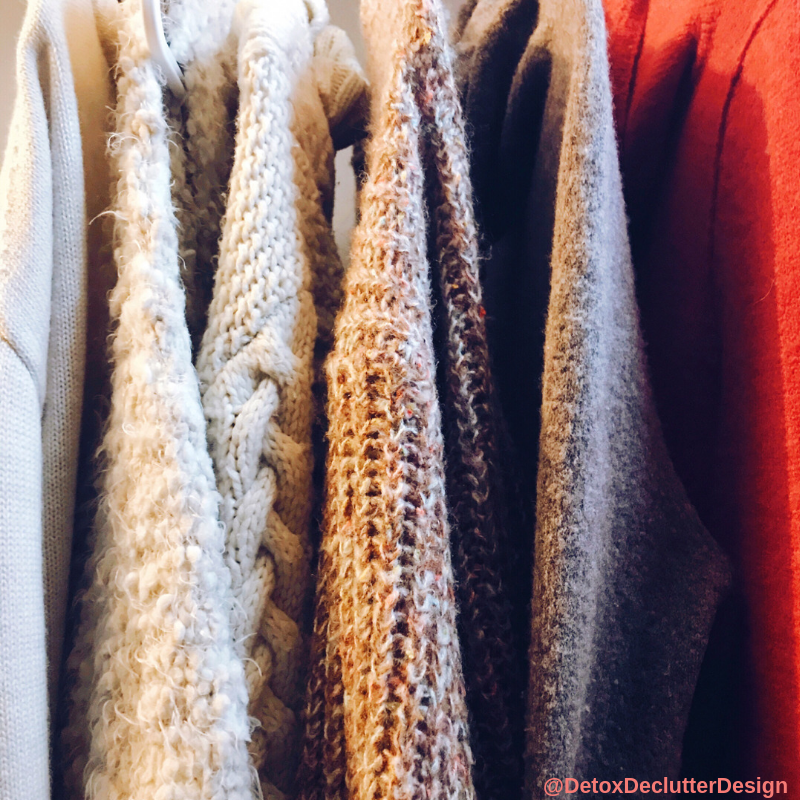
A shot of my closet; all the colours match with the sweaters in the heading photo of this post!

A Wardrobe Colour Scheme results in a Simplified Closet

My wardrobe had decreased significantly after my final purge and I am in love with the results. I am sharing this with you because I believe that one major method to creating a wardrobe that sparks joy and becoming a conscious consumer, is to create a structure for the things you buy. Determining what your colours are, what colours you love, and what looks good on you, will prevent you from purchasing items that don't spark joy or fit the rest of your style.

Additionally, you may end up having less than before even though it may not feel that way. Hear me out - if everything in your closet falls under a colour scheme, then at least 80% of the pieces in your closet should match (depending on what your chosen colour scheme is). When everything matches, you really don't need a lot of pieces to create multiple different outfits. This will also help with packing, as you can create more outfits from fewer items.

One colour scheme approach is using "colour families" instead of just single colours, to give yourself wriggle room. This approach is about helping you find focus and direction in your wardrobe, instead of enforcing a feeling of confinement.

Another client closet - colour scheme does not need to imply having lots of colour. If you like the neutrals, blacks, and whites, stick to those.

The Final Purge

I have been referring to my last closet decluttering as my "final purge." This is because this realization of what clothes and colours I love has helped me limit the amount of items I buy that are short-term fills. By this, I mean that we live in a consumer society where deals and access amounts of items are available to us, and in turn, we tend to buy things we don't absolutely love. I am hopeful that the structure of a specific colour scheme will help me maintain a minimal wardrobe of pieces I love and that are long-lasting.

Less is more. This client put her clothes she loved back into her closet after purging and then did not want to ruin the simplicity of the closet by adding items she didn't fully love. Be picky! Use this method to help identify your colour scheme.

Progress not perfection

Now that you have read all this information, here is the most important takeaway: don't worry about making it perfect. My wardrobe is still far from perfect and I could probably still consume less and "want" less. It's really all about progress; I have become a more conscious consumer and I have created and continue the process of creating a wardrobe that is sustainable, functional and represents me. Don't stress about the little things. Don't worry if you have a shirt you love but that doesn't fit into the rest of your colour scheme. That's okay! If you love it, keep it! It's that simple ... so don't over complicate! 

Reach out! 

Are you interested in purging your closet? Or have you been purging and now want to find your colour scheme around which to build your wardrobe? Or do you have questions about what a conscious consumerism is or tips on how to become a more conscious consumer? Reach out to me! Send me an email, leave a comment, or DM me on Instagram! I would be so happy to hear from you!


SHARE:
© D3. All rights reserved.
Blogger Templates by pipdig